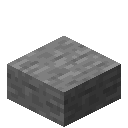
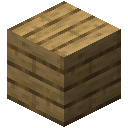
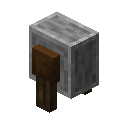
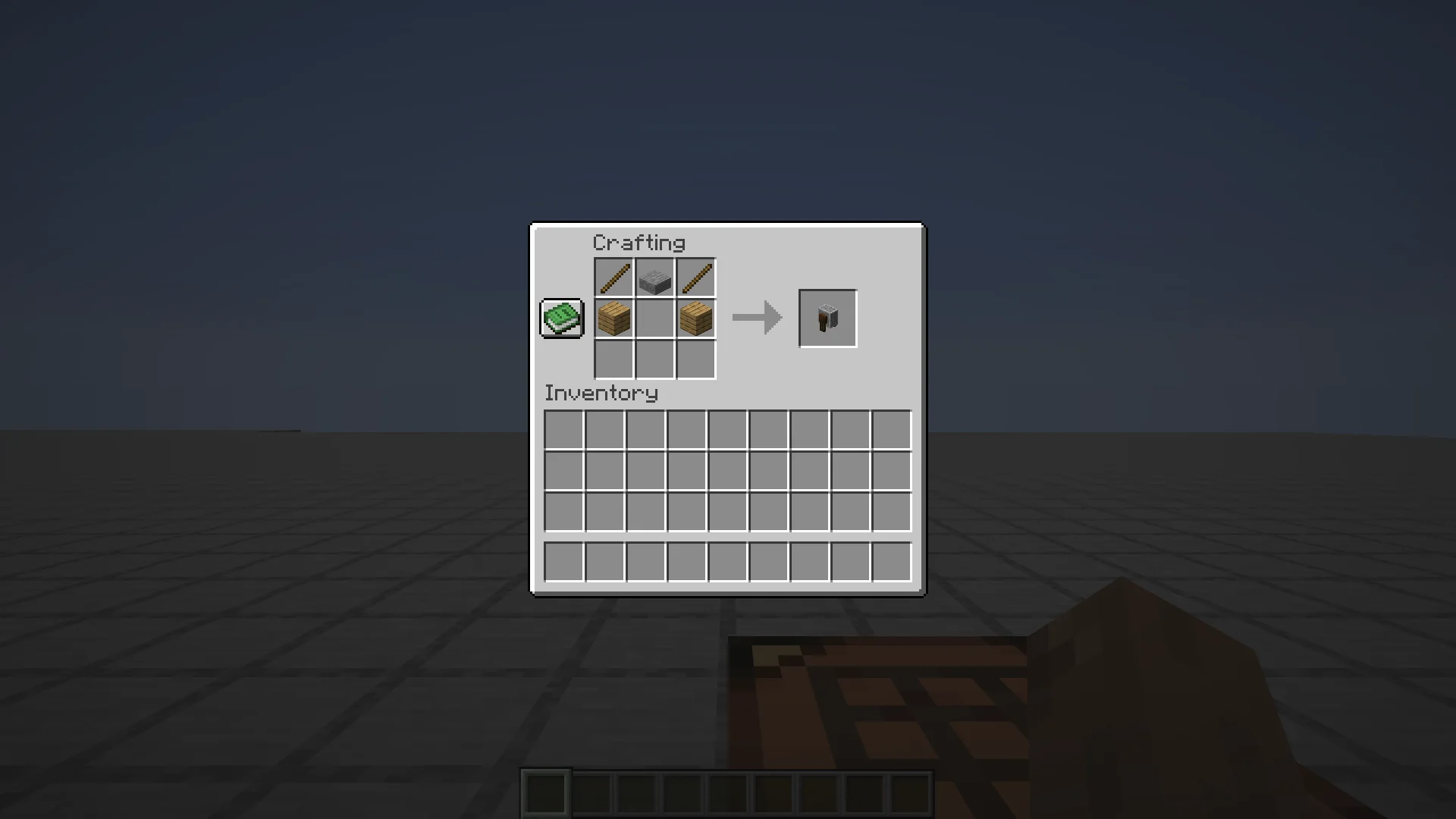
A grindstone allows you to remove unwanted enchantments from gear, recover raw experience points, repair damaged equipment without spending levels, and reset accumulated anvil penalties. Crafting a grindstone requires two sticks, one stone slab, and two wood planks arranged on a crafting table.

oak_planks ∈ #minecraft:planks
Open the full recipe and material calculatorGrindstone Crafting Recipe and Component Requirements
To craft a grindstone, arrange your ingredients across the top two rows of a 3x3 crafting grid:
- Top row: Place one stick in the left column (slot 1), one stone slab in the middle column (slot 2), and one stick in the right column (slot 3).
- Middle row: Place one wood plank in the left column (slot 4), leave the center empty (slot 5), and place one wood plank in the right column (slot 6).
- Bottom row: Leave all three slots empty.
The slab ingredient must be a standard stone slab, made by smelting cobblestone into stone and placing three stone blocks in a row. Cobblestone slabs, smooth stone slabs and stone brick slabs do not work. The two wood planks can come from any timber variety, and you can mix different species such as oak and birch without breaking the recipe.
Disenchanting Items and Experience Refund Formula
Placing an enchanted weapon, tool, armor piece, or enchanted book into either input slot of the grindstone immediately strips all non-curse enchantments. Disenchanting an enchanted book turns the item back into a standard, unenchanted book.
When you take the disenchanted item out of the output slot, the grindstone drops experience orbs directly at your location. In Java 26.3 the amount follows a fixed formula based on the minimum enchanting cost of each removed enchantment:
- The game reads each removed enchantment and looks up its minimum enchanting cost. For example, Sharpness V has a base cost of 45, and Unbreaking III has a base cost of 21.
- The base costs are summed across all removed enchantments into one total.
- The game halves the total, rounding up.
- You receive that half plus a random extra amount from zero up to one less than that half.
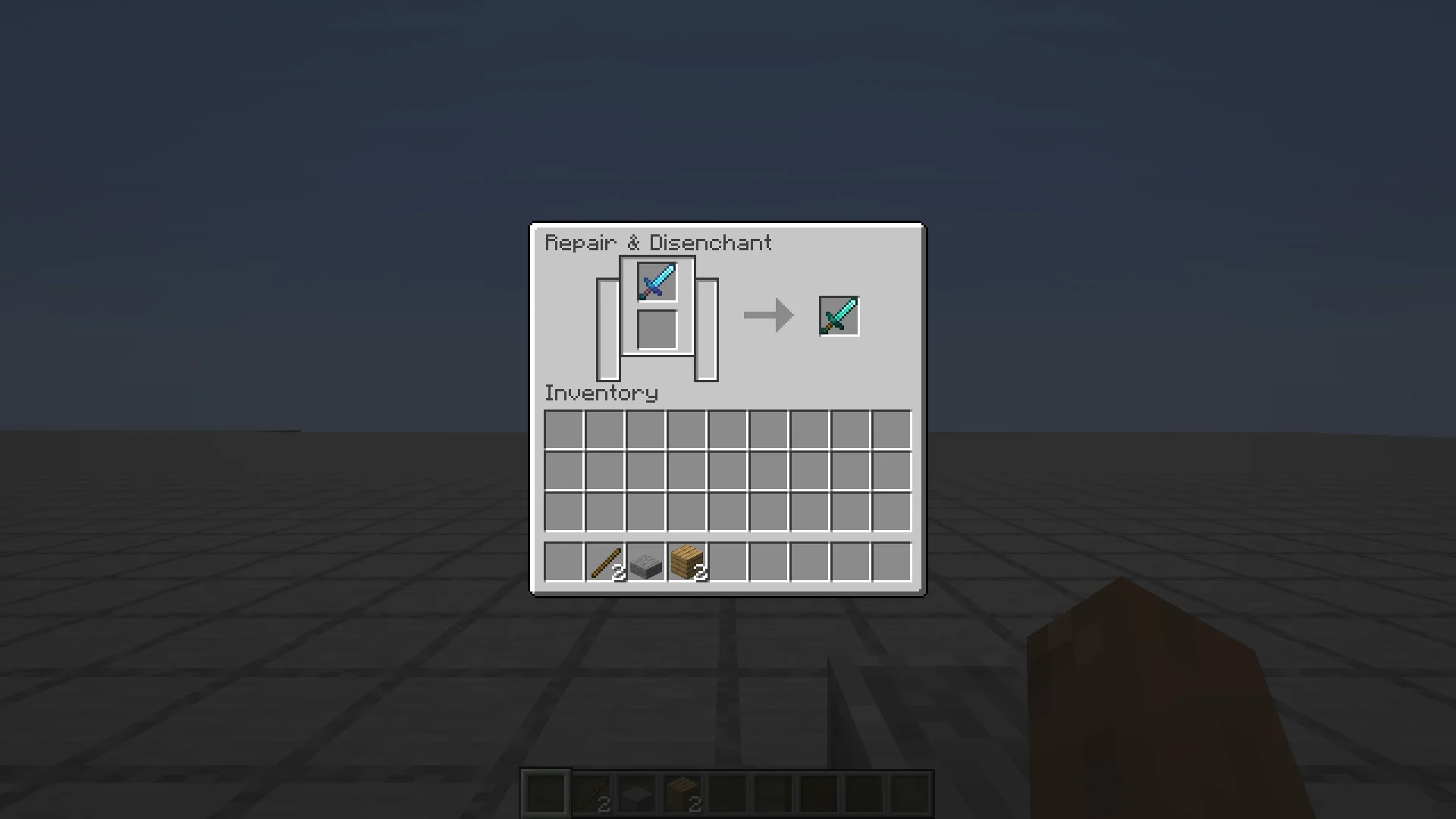
This formula guarantees an experience refund between 50% and approximately 100% of the combined base cost. A diamond sword with Sharpness V (cost 45) and Unbreaking III (cost 21) gives a total cost of 66, returning between 33 and 65 experience points when disenchanted. If you need to re-apply enchantments later, check our guide on the enchanting table.
Curse Immunity and Prior Work Penalty Reset
The grindstone cannot remove curses. Curse of Binding and Curse of Vanishing stay on the item. When an item with both standard enchantments and a curse passes through the grindstone, the standard enchantments are stripped and refund experience, but the curse remains intact on the output item.
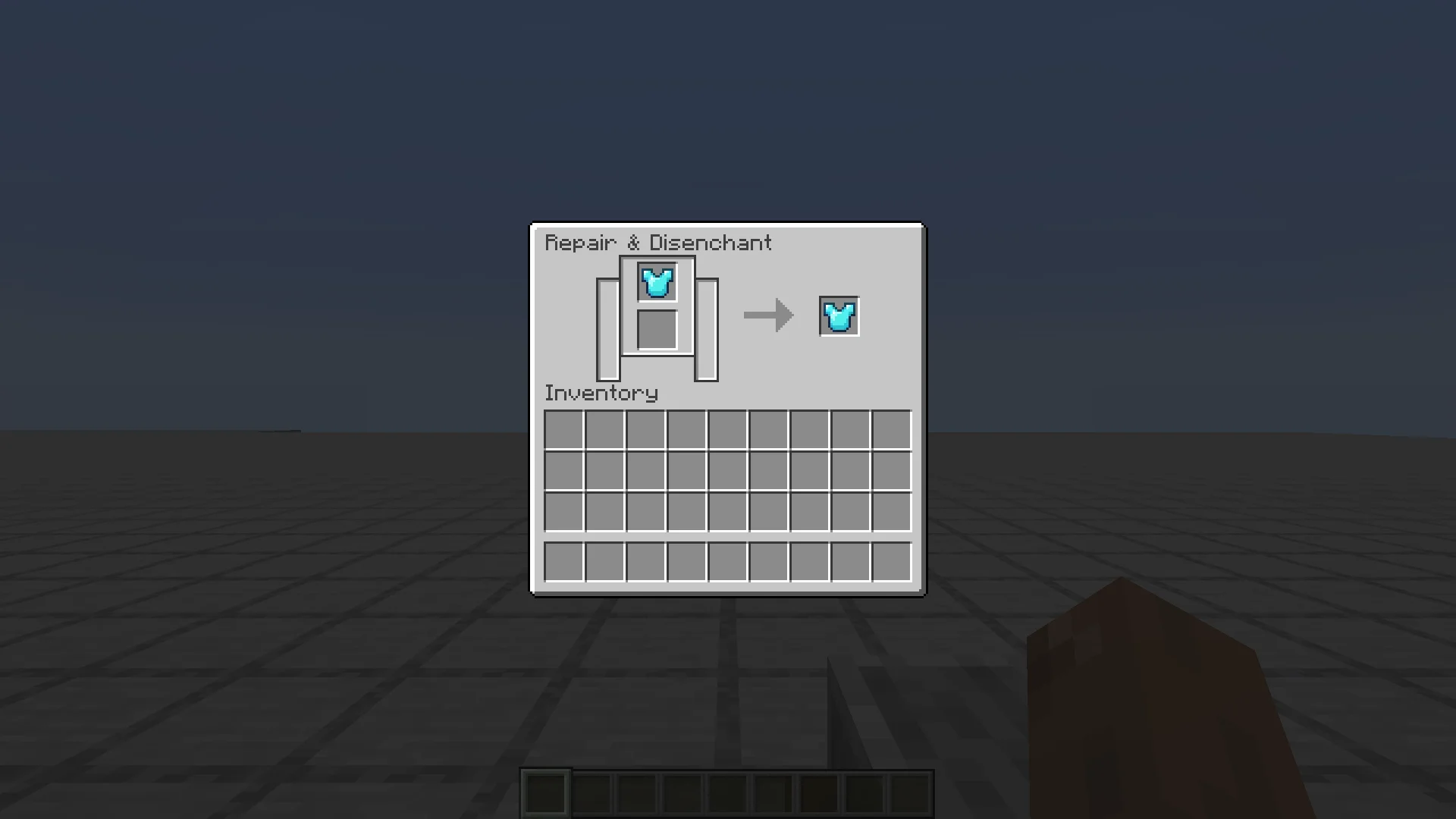
Crucially, disenchanting an item completely wipes its accumulated anvil repair history. Each time you combine items on an anvil, the item gains a prior work penalty that makes the next anvil step more expensive. Once a single step would cost 40 levels or more in Survival, the anvil shows "Too Expensive!". The grindstone sets the penalty back to zero when no curses remain (an item that keeps a curse gets a small penalty for that curse), so you can enchant it again from scratch.
Combining and Repairing Two Items with a 5% Durability Bonus
You can place two damaged items of the same type into the top and bottom input slots to combine them into a single repaired item. Unlike an anvil, this repair costs zero experience levels and does not consume iron.
The grindstone calculates restored durability using this formula:
Combined Durability = Durability(Item 1) + Durability(Item 2) + floor(Max Durability * 0.05)The game adds the remaining durability of both items and grants an extra 5% bonus calculated from the item's maximum durability value, capped at the maximum durability rating. For example, an iron pickaxe has a maximum durability of 250 points:
- Pickaxe 1 has 100 durability remaining (150 damage).
- Pickaxe 2 has 50 durability remaining (200 damage).
- The 5% bonus provides
floor(250 * 0.05) = 12bonus durability points. - The resulting pickaxe possesses
100 + 50 + 12 = 162durability (88 damage).
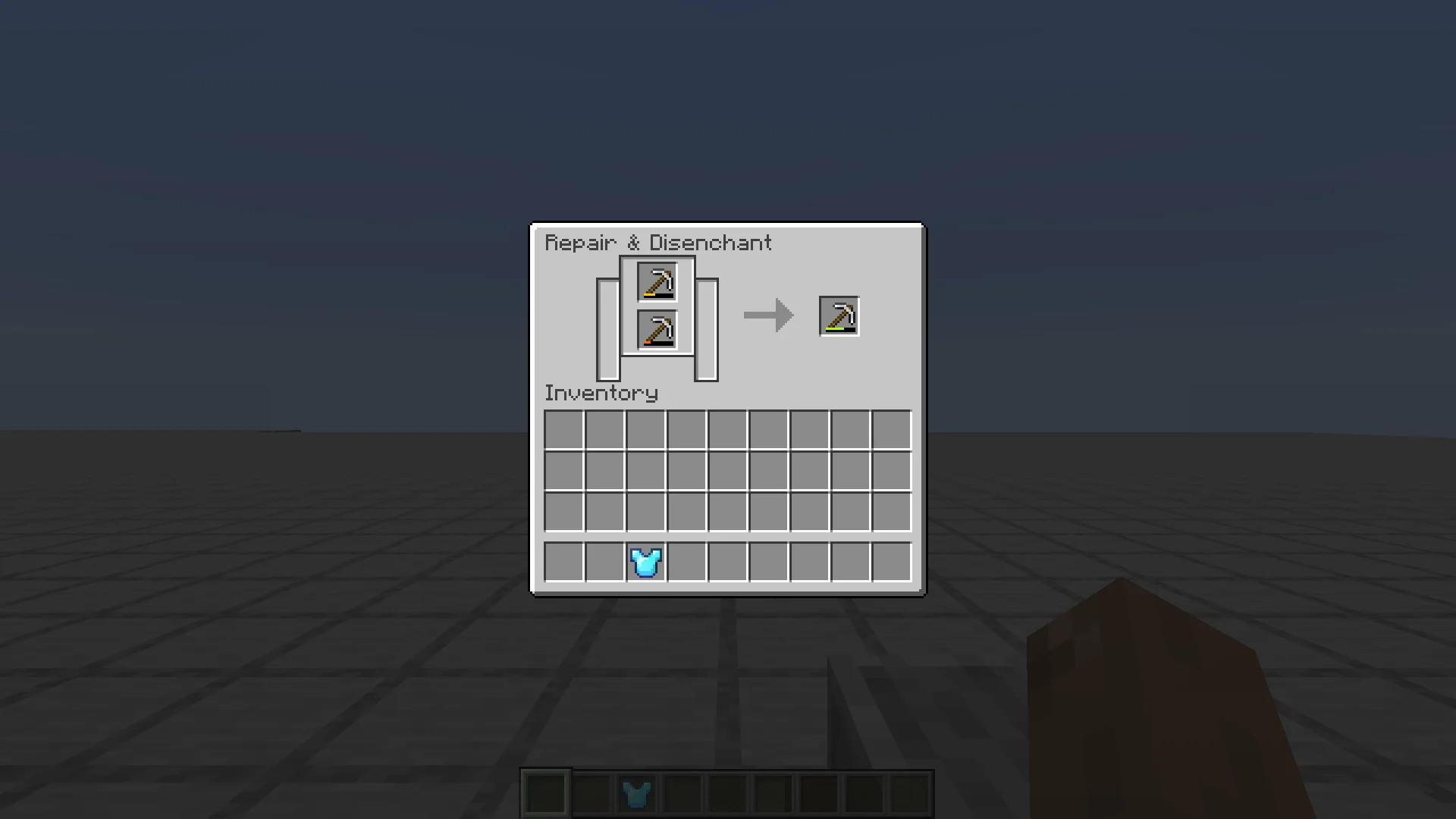
Be aware that combining items on a grindstone also strips all non-curse enchantments from both inputs. Only use the grindstone to repair non-enchanted tools or equipment whose enchantments you intentionally want to discard.
Grindstone vs. Anvil: Key Differences
While both blocks handle item repairs, they serve opposite roles in equipment management:
| Feature | Grindstone | Anvil |
|---|---|---|
| Enchantment Handling | Removes non-curse enchantments and refunds XP | Combines and preserves enchantments |
| Repair Cost | Free (0 experience levels) | Costs experience levels (1 to 39+ levels) |
| Durability Bonus | Adds 5% bonus of max durability | Adds 12% bonus of max durability |
| Enchanted Book Application | Cannot apply enchanted books | Applies enchanted books to gear |
| Item Renaming | Cannot rename items | Renames items for 1 level |
| Prior Work Penalty | Resets repair cost penalty to 0 | Increases penalty with every repair |
| Block Durability | Never breaks or degrades | Degrades and breaks after ~25 uses |
| Crafting Cost | 2 sticks, 1 stone slab, 2 planks | 3 iron blocks, 4 iron ingots (31 iron) |
Weaponsmith Job Site Block and Mounting Orientations
A grindstone acts as the job site workstation block for the Weaponsmith villager profession. Placing an unclaimed grindstone in a village allows an unemployed villager to claim it, equipping a black leather apron and an eyepatch. Weaponsmiths trade iron, bells, enchanted iron swords, and enchanted diamond weapons at master tier.
Unlike anvils, which obey gravity and can only sit on horizontal floor surfaces, grindstones support three distinct mounting orientations:
- Floor: Sits upright on top of any solid block face.
- Wall: Mounts horizontally against vertical walls, projecting outward like a wall fixture.
- Ceiling: Hangs upside down from the underside of ceiling blocks.
Grindstones do not fall when the supporting block is removed, making them versatile decorative and functional elements in compact smithy builds.
FAQ
Can a grindstone remove Curse of Binding or Curse of Vanishing?
No. The grindstone never removes curses. If an item has both normal enchantments and a curse, the grindstone strips the normal enchantments and returns experience, but the curse remains on the item.
Does using a grindstone reset the anvil prior work penalty?
Yes. When you disenchant an item without curses, the grindstone sets the repair cost component back to zero. This completely clears accumulated prior work penalties, allowing you to re-enchant the item on an anvil without encountering the 'Too Expensive!' error.
Why does the crafting table recipe require a stone slab instead of cobblestone?
The recipe asks for the plain Stone Slab, made from three Stone blocks (smelted cobblestone). Cobblestone, deepslate and smooth stone slabs do not work.
How does repairing items on a grindstone compare to an anvil?
A grindstone repairs two identical items for zero experience levels and adds a 5% durability bonus, but strips all non-curse enchantments. An anvil preserves and combines enchantments, allows custom renaming, and accepts enchanted books, but costs experience levels and slowly degrades until it breaks.