Redstone dust is used in wiring, repeaters, comparators and many other automation components.
For modern Java terrain, take an iron pickaxe or better down to Y=-58 or Y=-59. That is where redstone is most concentrated. Dig a small branch mine through deepslate, light the route, and keep a water bucket on the hotbar before opening a fresh vein.
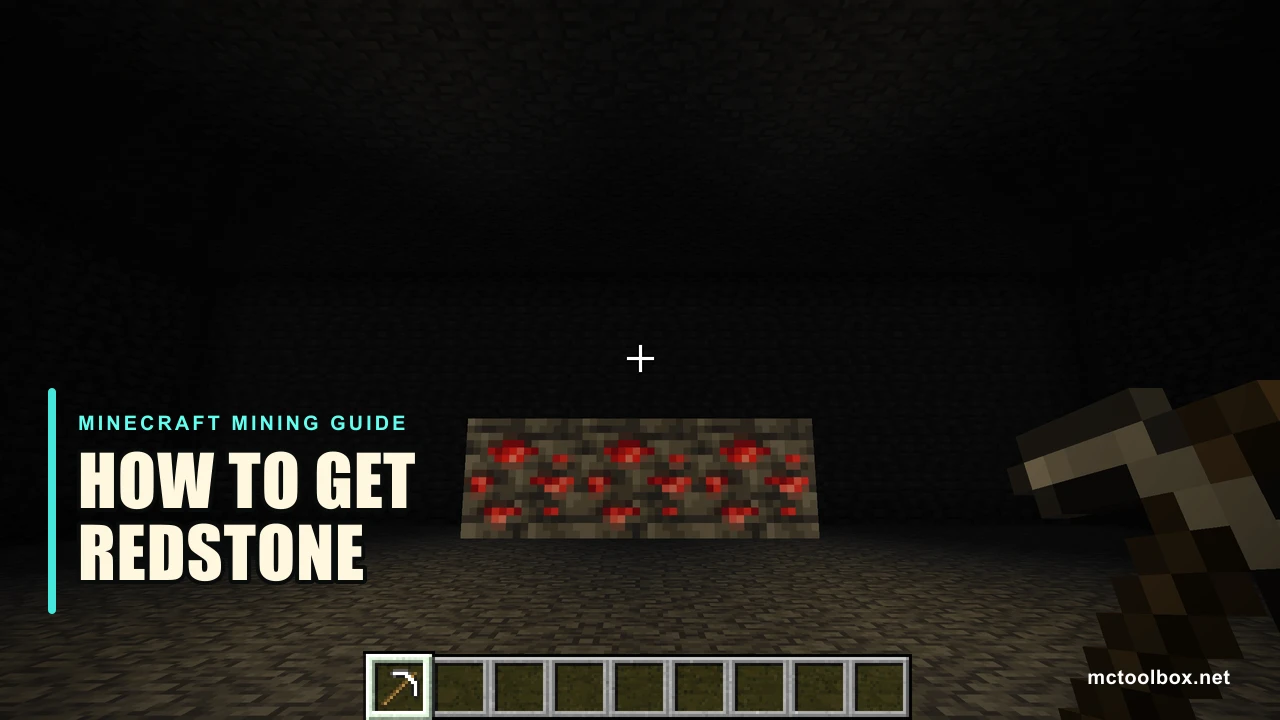
Tunneling down to deepslate redstone levels
Open the Java debug screen with F3 and watch the middle coordinate. The number after Y: is your height. Descend until it reads about -58 or -59, then make a level two-block-high tunnel. Staying near that depth gives you strong redstone odds without trying to tunnel through the bedrock floor itself.
If you would rather compare several materials before digging, the ore distribution tool is a quick way to see where each Overworld ore becomes useful.
Harvesting redstone ore with the right pickaxe tier
In the deep layers, the ore usually appears as deepslate redstone ore: dark grey blocks with a bright red pattern. Break it with an iron, diamond, or netherite pickaxe. A stone pickaxe can clear the tunnel around it, but it will not give you the redstone dust when you break the ore itself.
Do not mine every redstone block immediately if lava might be underneath. Expose the sides, top, and bottom first. A water bucket turns a sudden lava pocket from a lost haul into a short delay.
Fortune III vs. Silk Touch: Maximizing dust yields
For an ordinary survival world, Fortune is the straightforward choice. It gives more redstone dust from the ore, which is useful once repeaters, observers, pistons, and powered rails start to consume stacks at a time.
Silk Touch is the alternative when you want the ore block itself for a build, storage, or a later Fortune pickaxe. It does not create extra dust at the moment of mining, but it lets you move the ore safely. The two enchantments solve different problems, so keep them on separate pickaxes instead of trying to combine them.
First automated wiring: Torches, repeaters, and pistons
A redstone torch is the smallest useful first craft. It powers a block directly and introduces the idea that redstone can carry a signal.


Crafting ingredient: what a redstone torch is used for
Redstone torches become ingredients in repeaters, comparators, and activator rails. Make a small stack before starting a build that needs timing or signal control; they are cheap, but repeatedly returning to craft one torch interrupts the flow.

The Redstone Delay Calculator helps once repeaters are involved, while the crafting guide is useful when you need a wider component chain for pistons, observers, or comparators.
Where redstone mining goes wrong
The usual mistake is digging too high, not digging too fast. Redstone still appears above the best layer, but a player who wants enough dust for a project will spend longer seeing empty stone. The other common mistake is treating a deep cave as automatically better than a branch mine. Caves expose plenty of blocks, but they also add drops, water, hostile mobs, and lava. Use a cave when it is already open and safe; use a tunnel when you want predictable progress.
Bring spare iron pickaxes, torches, food, and blocks that do not burn. Redstone is common enough at the right depth that a careful route pays off, but the same low layers are where every small lava pocket becomes expensive.
Redstone IDs and commands
| Item or block | Java Edition ID | Use |
|---|---|---|
| Redstone Dust | minecraft:redstone | Wire, torches, repeaters, and components |
| Redstone Ore | minecraft:redstone_ore | Stone-layer ore block |
| Deepslate Redstone Ore | minecraft:deepslate_redstone_ore | Deep-layer ore block |
| Redstone Torch | minecraft:redstone_torch | Basic power source |
In a Java Edition world with commands enabled, use /give @p minecraft:redstone 64. The MC Toolbox /give generator can build the command with a chosen count or item ID.
Redstone gathering and mining questions answered
What is the best Y level for redstone?
For modern terrain, mine around Y=-58 or Y=-59. Redstone generates below Y=16, but it is most concentrated close to the bottom deepslate layers.
Can a stone pickaxe mine redstone ore?
No. Use an iron pickaxe or better to receive redstone dust. A stone pickaxe can break the block, but it does not collect the drop.
Should I use Fortune or Silk Touch on redstone ore?
Use Fortune when you need more dust. Use Silk Touch only when you specifically want to carry the ore block elsewhere or save it for later.
Do I need to smelt redstone ore?
No. Mine the ore with an iron pickaxe or better and it drops redstone dust directly. A furnace is not part of the usual redstone workflow.
Why is redstone mining dangerous at the best level?
The best redstone layers sit close to deep lava and bedrock. Light the tunnel, expose a vein before breaking it, and carry water or safe building blocks.